An End-of-Year Ritual for people with a 'graveyard' of notes
Let’s get the obvious out of the way: I haven’t sent a newsletter in months. If you subscribed recently, this might literally be the first time you’re hearing from me. That’s not some grand strategy – I’ve just been focused on other projects.
I’m not going to pretend there’s a noble reason - I’ve just been heads-down on other work and not forcing myself to “send something” for the sake of it.
As we quickly head toward the end of the year, I’m back with a small series on the real end-of-year rituals I actually use. Don’t worry these are not the usual “set 47 goals and buy a new planner” advice.
Today we’re starting with the Personal Zeitgeist Ritual.
I take a lot of notes. Like, *a lot*.
Throughout the year, I am constantly collecting ideas. Snippets from podcasts, quotes that stopped me in my tracks, articles I swore I’d read later, and random shower thoughts that seemed brilliant at 6am.
Some of them have gone on to become articles, content, offers and form bigger ideas.
But if I’m honest, a lot of them are still sitting in my Knowledge Hub sadly forgotten.
I know I’m not alone in this. We all have that digital notes app that feels a bit like a graveyard. It’s full of half-baked ideas and “sparks” that we never actually did anything with.
And it’s easy to let guilt set in right about now.
We look at that pile of unprocessed notes and we feel like we failed. We think, “I should have organised this better” or “I was supposed to *do* something with all of this.”
But what if instead of thinking about them as a graveyard we revived them (and no I’m not suggesting you spend the next 3 weeks processing all your notes from the last year).
These notes are breadcrumbs of your curiosity over the last 365 days. They are a map of your mind. They might actually be the most interesting insights about who you are and what you actually care about.
So this year, instead of trying to “process” my backlog (which honestly sounds like a terrible chore), I decided to run an experiment.
I developed something I am calling The Personal Zeitgeist End Of Year Ritual
The “Personal Zeitgeist” Experiment
“Zeitgeist” is usually used to describe the spirit of an era or a culture. But I believe we all have a *Personal* Zeitgeist—a hidden current that runs through our thinking for the year.
Maybe you thought you were interested in “productivity,” but your notes reveal you were actually obsessed with “rest” and “slowing down.”
Maybe you thought you were focused on “marketing,” but your saved articles show a deep fascination with “storytelling psychology.”
It’s hard to see these patterns when you are in the thick of it. As Steve Jobs said,
“You can’t connect the dots looking forward; you can only connect them looking backwards.”
But let’s be real—you also can’t connect the dots by manually reading 500 random notes. You are too close to the ideas.
So I hired an “Intellectual Historian” to do it for me.
(Spoiler: It was AI).
How I Run My Zeitgeist Ritual
You don’t need a fancy system to do this. You just need your notes and an AI model with a large context window (I used Gemini for this, but Claude or ChatGPT work great too).
Here is the exact process I used to turn my “graveyard” into a goldmine:
Step 1: The Harvest
Go to wherever you keep your notes—Tana, Obsidian, Notion, Apple Notes, or even a stack of Word docs and export them.
You don’t need them to be formatted perfectly. You just need the raw text. Export them as a Markdown file or a text file.
(and if you use Tana & wonder why I’m not doing this with the built in AI in Tana. The answer is - I have too many notes and it would use up all my credits. So I prefer to use an external tool)
Step 2: The Analyst
Do not just ask for a summary. Summaries are boring. You want an *analysis*. Upload that file to AI & use the following prompt that plays the role of a Cultural Analyst.
Here is the exact prompt I used:
[System Role: You are an expert Cultural Analyst and Intellectual Historian. You specialize in “Personal Zeitgeist” analysis—detecting the subtle shifts, obsessions, and mood of a single human intellect over the course of one year.

The Data: I am providing you with my “Spark Notes” from this year. These are not journal entries about my feelings or daily life. They are fragments of knowledge, quotes, article summaries, and sudden realizations I collected. They represent my intellectual consumption and creation.

Your Objective: Analyze this text to construct a “Personal Zeitgeist” report. You must look beyond simple topic frequency. I want you to identify the underlying current of my thinking.

The Output Structure: Please parse my notes and return a report with the following distinct sections:

1. The “Ghost” in the Machine (The Central Theme)
What is the one idea, concept, or question that haunted me this year?Identify the thread that connects seemingly unrelated notes. (e.g., “You collected notes on biology, architecture, and software design—the hidden thread connecting them is ‘Modular Systems’.”)

2. The “Rabbit Hole” Report
Identify 2-3 specific topics where I went suspiciously deep.
What specific sub-niche captured my attention more than I might realize?

3. The Unturned Stone
Based on what I consumed, what is the obvious counter-argument or adjacent field I completely ignored? (What is the “blind spot” of my year?)

4. The Zeitgeist Definition
Summarize the “Spirit of the Year” in a single, evocative phrase (e.g., “The Year of Structure,” “The Year of Entropy,” “The Year of the Interface”).

5. The Intellectual Pillars (The Themes)
I am a multifaceted thinker. Identify the distinct “Pillars” that supported my thinking this year.
For each Pillar, provide:

The Name: A creative label for the theme (e.g., instead of just “Health,” use “The Bio-Optimization Protocol”).
The Synthesis: Summarize what I was thinking about regarding this topic. What was the specific angle or insight I kept coming back to?
What I discovered About Myself
When I ran this on my own notes it was fascinating. Some obvious things, but also some really fascinating rabbit holes I want to revisit:
The central theme for me this year was “The Operationalization of “Vibe” - this tension between structure and fluidity in my processes.
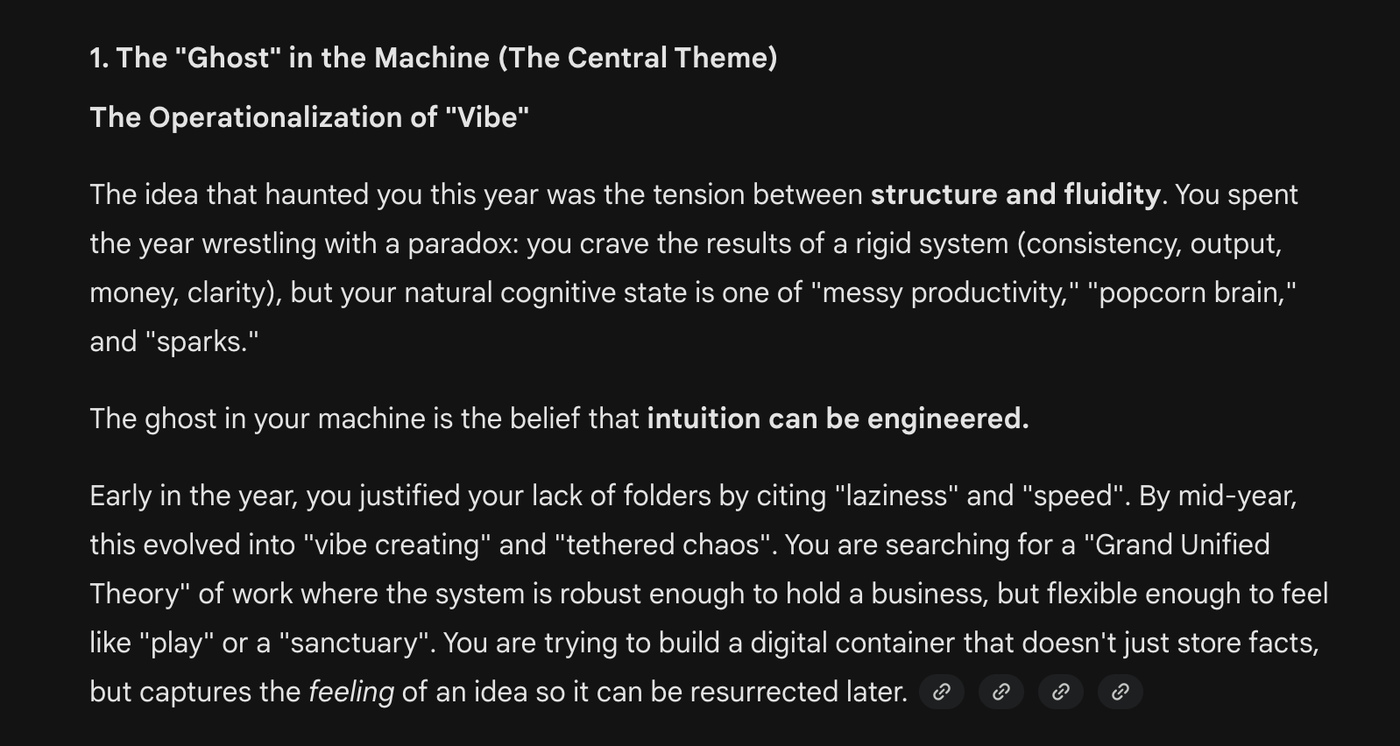
Rabbit Holes & Themes I was obsessed by:
- AI-Infused Second Brains & Active Knowledge Systems
- Context Engineering (The Care and Feeding of AI)
- Conversation as a New Primary Mode of Thinking
- Conversation as Cognition
- The One-Person Studio & Future of Work
- Headspace as the New Wealth
- The “Operator to CEO” Identity Shift
- Taste as the Human Moat
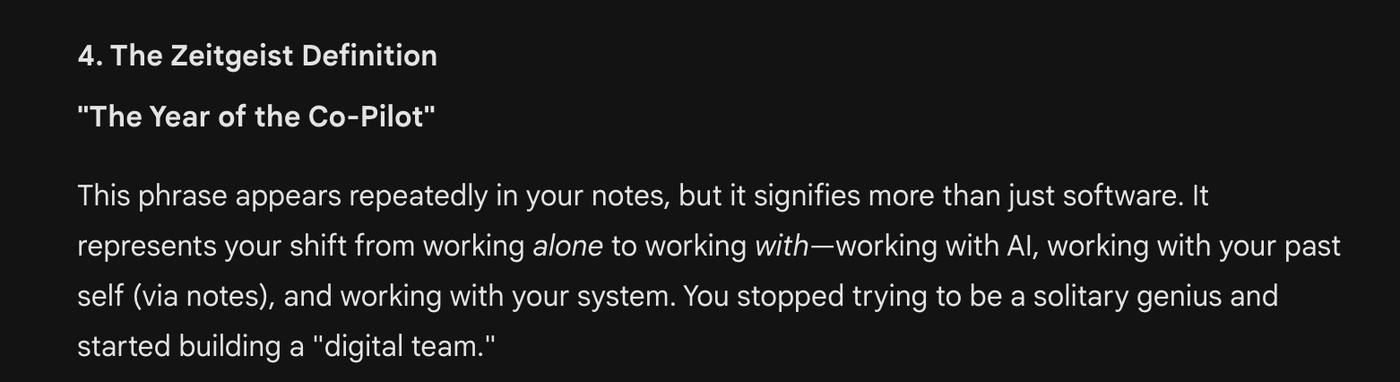
And essentially AI declared this year The Year Of The Co-Pilot. Which is undeniably what my year was about.
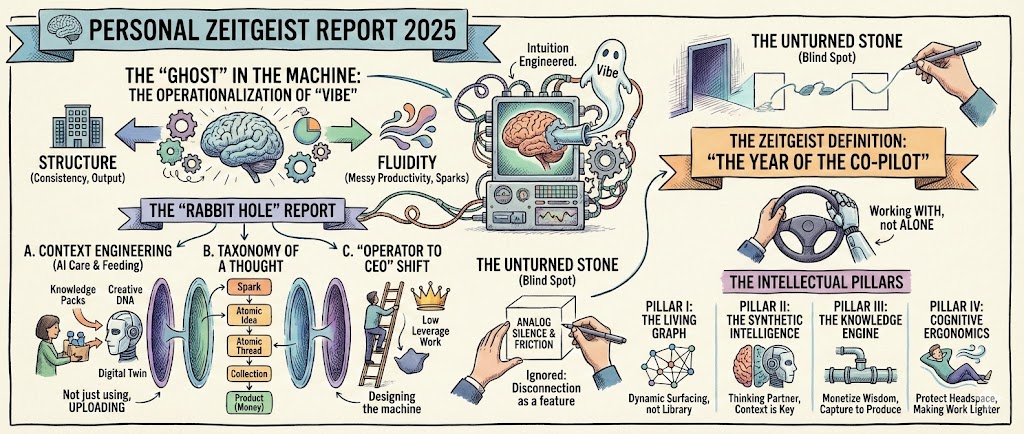
I even asked Gemini’s Nano Banana to create a Sketchnote of my report (this is one of my favourite things to do with Nano Banana by the way).
If you feel guilty about all those abandoned notes from the last 12 months, this is your redemption arc.
You haven’t been wasting time. You have been building a body of work.
So before you set your goals for next year, take ten minutes to understand your mind from this year. You might just find that the direction you need to go is already hidden in the notes you have already taken.
Trust me—it’s way more fun than reviewing your calendar.
— Ev
PS — If this idea of reviving your note graveyard has you thinking about your own system. Here are a couple of ways I can help:
- If your notes feel a bit like mine used to — overflowing but underutilised — you might enjoy my course Knowledge Alchemy, where I teach the system that finally stopped me losing good ideas to the abyss constantly.
- And if you want to explore more ways to use AI as a thinking partner in your notes then you might want to check out my AI Note-Taking Playbook. A BUNCH of prompts that I have collected and curated to help me think & build ideas in my notes.
Comments