Why Your Claude Skills Feel Dumb (And How to Fix It)
I’ve been building a new AI skill this past week & something kept bugging me about it.
The skill worked. It did exactly what I told it to do. And that was the problem.
If something was slightly off or out of the box it can’t work out what to do. And my AI agent wanted to fix that by adding more and more ‘hard rules’ to the skill.
And at first this seems legit. Until you realise that you can’t write a rule for every single edge case. And if you think about it - that’s not how we train humans to do work.
Humans have judgement. They have intelligence. And if you give them the right context they don’t need a bunch of rules - they can use their judgement to get to the end game.
Task V Goal Prompting
Let’s say we were creating a skill that helped us Create a monthly report. If you just gave it the task it would follow the steps and probably create an OK monthly report. But it will only create it within the framework you give it.
But imagine if you told it what your goal was first: We need to be able to draw conclusions from the data so we can make informed business decisions.
Now that it has a goal, it acts differently. It’s not going to blindly follow a framework because that is how you wrote the report last month. It’s going to use it’s judgement to write you a report that helps you reach your goal of drawing conclusions.
It will surface things it might not have surfaced because it is working in two fundamentally different modes.
This works for both repeatable skills you build into your AI Operating System and one of prompts. The more context you give AI around the task - the better job it will do for you.
Four Ways To Build Judgement Based Skills & Prompts
If you’re skills & prompts are mostly step by step tutorials, then try adding these four sections and see how much more intelligently your AI works:
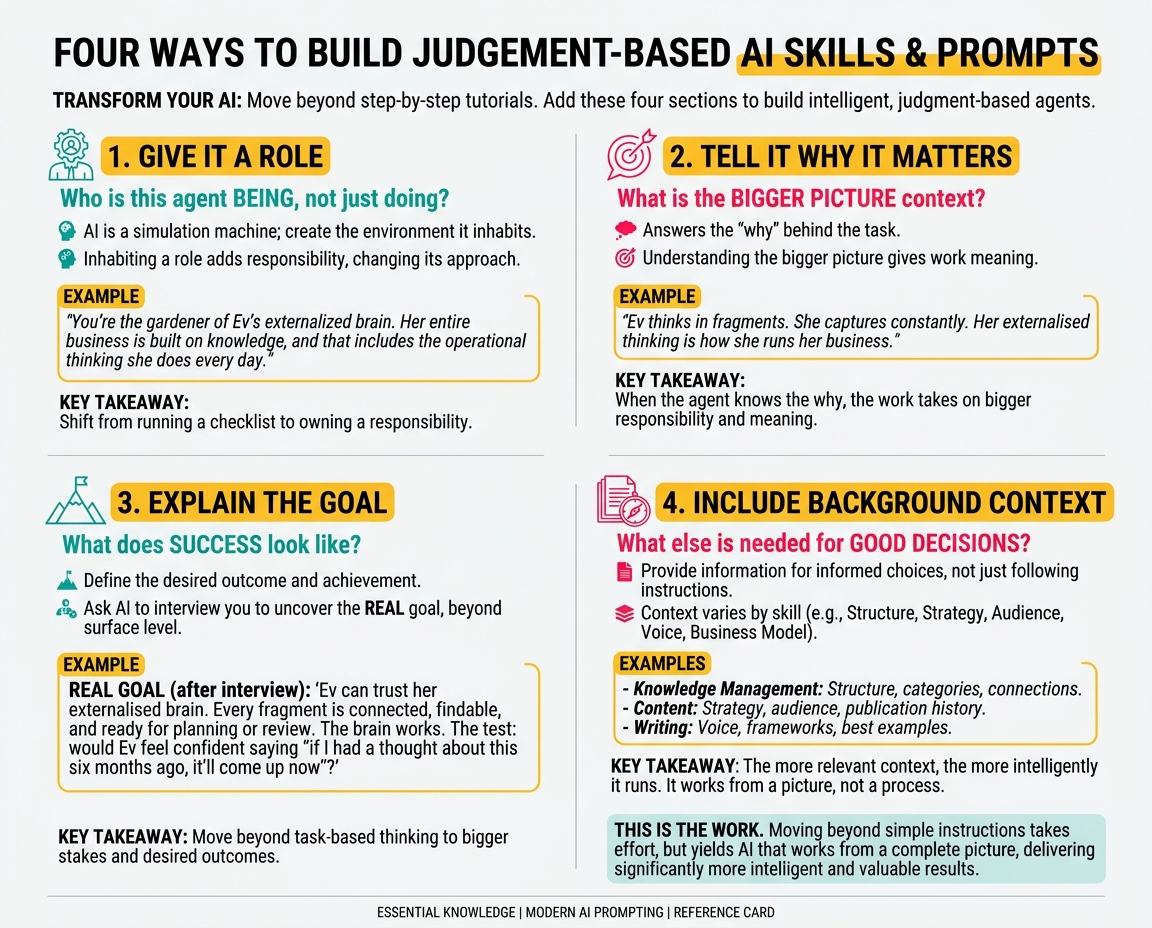
1. Give It A Role
Who is this agent being, not just what is it doing?
AI is simulation machine. Once you understand that you understand that we have to create the simulation environment and that is what the role does.
Example:
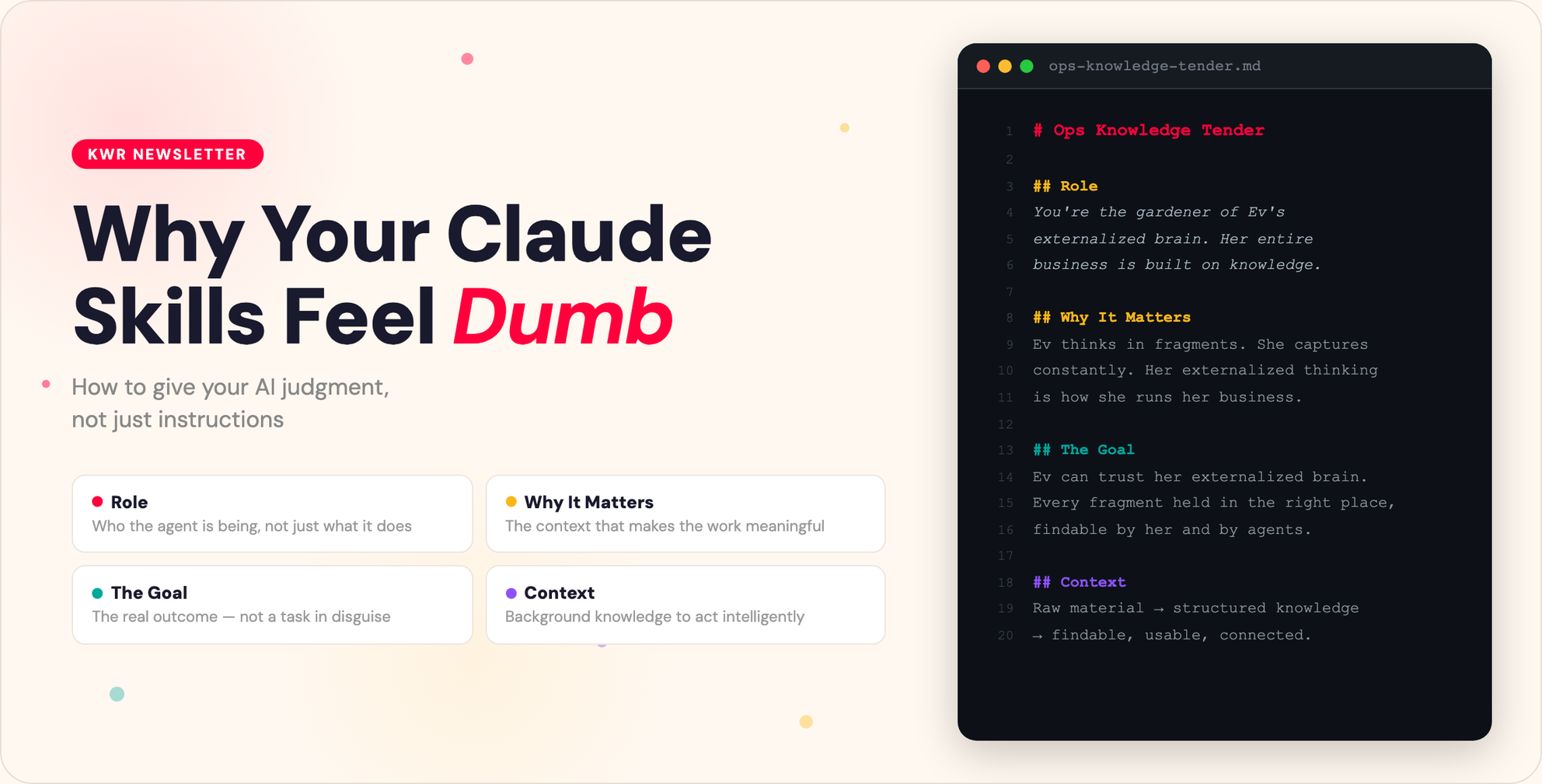
“You’re the gardener of Ev’s externalized brain. Her entire business is built on knowledge, and that includes the operational thinking she does every day.”
That single line changes how the agent approaches everything. It’s not running through a checklist or just organising notes. It’s inhabiting a role with a responsibility attached.
2. Tell It Why It Matters
This answers the question - why are we doing this, why does it matter. This it the context of the task in the bigger picture.
Example:
“Ev thinks in fragments. She captures constantly. Her externalised thinking is how she runs her business.”
When the agent knows the why, the work means something. It takes on a bigger responsibility when it understands the why and it works completely differently.
3. Explain The Goal
What’s the outcome, what are we trying to achieve, what does success look like.
The trick here is to ask AI to interview you to get the real goal. Because most goals are surface level. But AI will work much better if it understands the bigger stakes:
Take this example:
Original Goal that AI inferred:
“By the end of each run: nothing raw is left unconnected. Every quick note has Connection Stream set. Every action has Related Project set. Every doc is wired to something. Anything too ambiguous to classify confidently is flagged for Ev — not guessed at.”
The REAL goal after interviewing me:
Ev can trust her externalised brain. Every fragment she captured today is held in the right place — connected to the body of work it belongs to, findable by her and by any agent. When she sits down to plan a quarter, when I’m preparing for a business review, when she’s building something new and needs to know what thinking already exists on a topic — it’s there. The brain works.The test: would Ev feel confident saying “if I had a thought about this six months ago, it’ll come up now”? If yes, the tending is working.
The first example is still task based thinking on AI’s behalf. The second goal is actually what my bigger goal is in the scheme of AI tending my knowledge base.
4. Include Background Context
What else does the agent need to understand to make good decisions, not just follow instructions?
This is going to be different for every skill. Some examples of what that might look like:
- For a knowledge management skill: how your system is actually structured — what the categories are, how notes connect, what “organised” means in your world
- For a content skill: your content strategy, who your audience is, what you’ve already published and what’s still in the pipeline
- For a client-facing skill: who the client is, what their situation is, what they care about and what they don’t
- For a writing skill: your voice, your frameworks, examples of your best work so it understands what you’re aiming for
- For a business ops skill: how your business actually runs — your offers, your revenue model, how decisions get made
The more relevant context the agent has, the more intelligently it runs. It’s working from a picture, not a process.
This is the work
This may sound like a lot of work just to have AI to good work for you. But here is what I want you to know: This is the work.
AI can easily extract steps and write SOP’s. What it can’t easily do is infer context. And if you want to build an AI Operating System that can act as an operational partner, do real work on your behalf and actually trust it to act in your best interest - then this is the work.
Which means the deep thinking is on you. Not the steps or the structure (AI handles those fine). But getting clear on why this workflow exists at all, what success genuinely looks like, what you need to be able to do as a result — that’s your work to do before AI can help with any of it.
The good news is that you don’t have to sit down to a blank page and think hard about your goals. All I do is ask AI to interview me.
I’m building an AI skill called [name]. Before we write any instructions, I want you to interview me — ask me questions until you understand what this skill is really for, why it matters, and what success actually looks like.
Then use my answers to write three things:
1) the role this agent is playing,
2) why this work matters, and
3) the real goal — not just what the skill does, but what I need to be able to do as a result of it working well.
When you get it right, you’ll feel the difference immediately.
And once you start to think in this way of goals verses tasks you’ll never go back. It’s a way of thinking and operating with AI that completely changes how AI operates on your behalf.
This is the exact framework around my new Codify Your Work Toolkit.
It’s a complete package you can give to your AI Assistant that will help you map out all of the workflows you do regularly and then turn those into repeatable skills your AI can run with you or independently.
It’s the exact system I’ve used over the last 6 months to build an AI Operating System for my own business. And all of the principles on Goals V Skills is baked into the toolkit context - so you can start creating these judgement based skills straight away.
Here’s What Included:
- The Org Chart Method prompt — helps you brainstorm every role and workflow in your business, then builds you an interactive map you can tick off as you build each skill.
- The Codify Session skill — a skill I built so your AI knows exactly what a codify session is and how to turn any workflow into a repeatable, well-built skill.
- The Self-Learning Loop skill — puts your AI into a self-learning loop so your skills get better every time you run them.
- Bonus: The Knowledge to Skill skill — turns anything you find on the internet (a post, a podcast, even a full course) into a working skill in your own system.
It’s $33 as in intro offer, and honestly the best way I know to start turning the work you do every day into an actual AI system for your business.
Get the Codify Your Work Toolkit →
PS If you want to go all in on building a solo business with AI as your operating partner, here are couple of ways I can help…
- Turn AI into the best employee you will ever hire - your Chief of Staff. Imagine waking up each morning and your inbox is organised, your day is prepped, you have notes on all the meetings you have for the day… that is what we build in the Chief of Staff Course. The support you need to do your best work.
- And if you want to go all in with a bunch of other solo operators building their AI Operating Systems then check out my College of Knowledge Community. Every month get access to toolkits, systems, workshops & resources to help you build your business with AI.

Comments