.png)

Sorry to break it to you... but I'm not your AI hype girl.
You'll very rarely see a newsletter about the latest AI model. It's not that I'm totally uninterested in AI models. They just don't excite me that much anymore.
For the last month my feed has been FULL of the Fable release rollercoaster: Fable is back, Fable is going away, Fable is extended for another week, and another, and now it's here for good.
Then last week the new Opus 5 dropped. And I watched half my feed lose their minds over it. Half of them think it's incredible, the other half are convinced it broke everything they have every built.
(I even heard Boris Cherny the creator of Claude Code tell everyone they should delete their whole Claude Code setup every 6 months and start again)
I couldn't think of any worse advice. Maybe that works for engineers who code. But not for busy solo operators - we don't have time to delete everything and start again. That would be like firing an employee every 6 months and starting again. Which is CRAZY.
We need AI systems that compound, not break with every new model or new tool. We need AI systems that are continuously learning new skills, understanding how we work, helping us with our work and growing with us.
That's why I've stopped building my business around whicever model happens to be the newest, and started building it around a foundation instead.
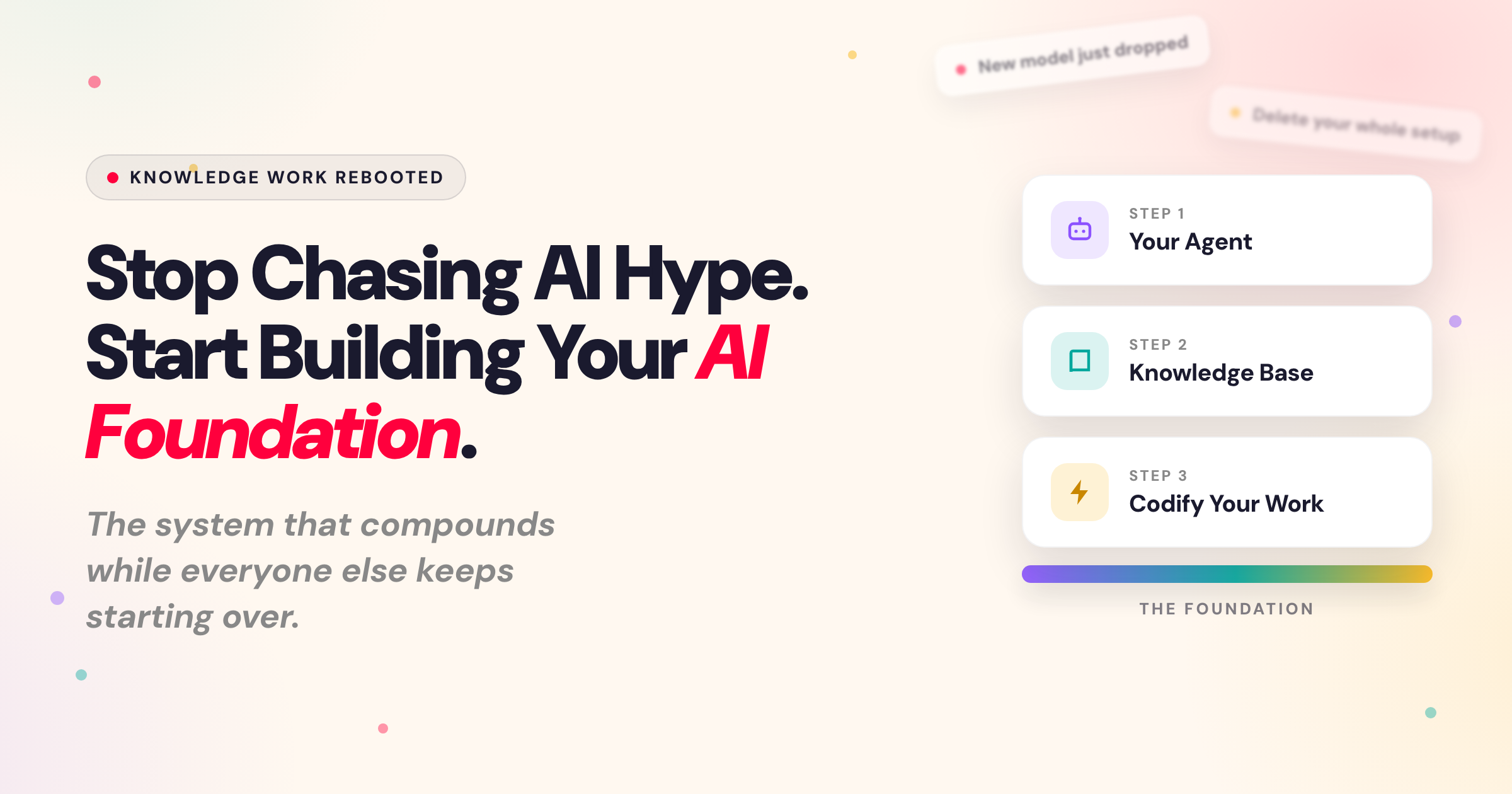
I call the foundation my Agent Operating System. It's one place where I can actually operate my business with AI. It's three systems, that work together so that AI understands me, knows how to work with me, has all the context of my business and work and actually knows how to do the work.
And I believe that every solo operator should be building towards a system like this.

Rather than thinking about working with an AI chat. Start thinking about building an agent that can work with you. I find this changes now only your setup, but your mindset. You start to think like AI as an employee than a tool.
You don't need 25 agent swarms for this either. For most solo operators, one single agent that holds the context of your business is enough. I call mine - my chief of staff (or more affectionally known as Chad)
And setting up an agent isn't as scary as you might think it is. You just need to do two things: Choose a platform, and create your agent directory.
Your platform is simply the place you open every day to actually work with your agent, the same way you'd open Gmail to check your email.
Some options are: Claude Cowork, Claude Code, Hermes, OpenClaw, and the new Tana are all great platforms. As a good start I find most people are comfortable with something like Claude Cowork.
Here's the actual simple thing about setting up an agent. Every agent is just a bunch of markdown files in a folder on your computer. Whatever platform you choose, you just open that folder and start chatting with your agent.
This actually makes the whole thing portable. I can open up Chad in Claude Cowork, Codex, or Claude Code and be talking to the same 'agent.'
Inside your agent directory you'll want to start with three files
By the way if you don't want to spend weeks figuring out how to do this, that's exactly why I built the AI Chief of Staff course. It walks you through the whole agent setup, connecting your knowledge base & includes 9 chief of staff skills to get you started. I promise it will change how you work with AI so check it out.
I've been helping people build their second brain for the last five years. And I always knew it was an unfair advantage for people. But now AI is on the scene it's become a non-negotiable.
Your second brain is now the externalised knowledge of your work and business shared between you and AI. You bring everything that lives in your head and scattered across your tools in one place where you AI has access, so you don't have to keep explaining yourself every single conversation.
And the best part is that AI can do most of the heavy lifting that made building a second brain too hard in the past.
First you'll want to choose somewhere to host your second brain. There are plenty of options here but I would say the on requirement is that AI can access it. This could be a bunch of markdown folders in your agent directory. Or you could choose a note-taking app like Tana or Notion. Neither is better or worse than the other - it's a personal decision based on what you like.
There are a billion ways to organise your second brain. So if you already have a way that works, take this with a grain of salt.
But after working with hundreds of people of the past five year, this is the structure that I have found works best for me.
I call it the Types Knowledge Base System. It's based loosely on object orientated note-taking, my experience with Tana Supertags, and also Google's new Open Knowledge Format that is becoming the standard for AI knowledge wikis

What I love working about the types system is that I never have to wonder where something should live. If it's a task I know it's going into the task folder/supertag. If it's an improvement, issue, project, etc. you get the gist.
I also am at the point where I actually organise none of this myself anymore. It's all organised by my agent. If you want to know how I do that I just wrapped up a workshop called The AI Knowledge Base Toolkit where I show you how.
This is the part that actually turns your agent from something you have nice conversations with into something that operates inside your business. It's also the part most people skip because they don't realise they can actually train their agent to do the repeatable parts of their work.
And this comes back to the point of having an agent - and thinking of that agent as an employee. You've configured how it should show up for you in the agent directory. You've given it the context of your business. Codifying is about giving it skills so it knows what to do.
And the best part is you'll never actually have to write an SOP for your agent if you follow my Codify Your Work Method. I built it for busy solo operators who don't have time to train their agent. It works pretty simply:
Step 1: Do the work. Open a conversation with your agent and just get on with the work, exactly the way you'd normally do it. There's nothing to prepare and nothing to set up first.
Step 2: Codify it. Once you're done, there's only one extra thing to do. Ask your agent to turn what you just did into a repeatable skill.
"Turn what we just did into a repeatable skill I can run again."
Step 3: Run it. Next time that job comes around, just ask for it by name. You won't need to re-explain the whole thing from scratch, and you're not starting cold.
Step 4: Update it. Every time you run it, tell your agent to fold in anything that's changed.
"Update this skill with anything you learned this time: new preferences, edge cases, anything that didn't work."
I have used this EXACT method to codify over 50 of the workflows I do in my own business. And my community has codified hundreds of their own workflows the same way. Trust me when I say this will revolutionise how you work with AI in your business.
I also built a whole toolkit called Codify Your Work that you can hand to your AI and it walk you through the whole process. It will help you map out every workflow in your business, it has the full codify skill, everything.
Here's the part I love about working this way.
Everything I've put into this system over the past 9 months is still working for me today.
The context I gave Chad six months ago still runs every conversation I have with him today.
My knowledge base gets richer every week instead of being abandoned for whatever tool comes along next season.
And every skill I've codified keeps running, and gets a little better each time I use it.
I'm never reinventing the wheel. If I've already solved something once, it's still there the next time I need it.
So when the next model drops, and let's be honest it'll probably be before you finish reading this, it costs me nothing. I'm not rebuilding anything. I'm not spending my weekend rearranging things. A better model underneath just makes everything I've already built work better.
That's all I actually want from AI in my business. Not the newest thing, just something that keeps getting better at the work while I get on with doing it.
— Ev
.png)


.png)
Every week I share practical systems and workflows to help you build a personal agent operating system. The goal is simple: graduate from using AI as a chatbot to having it actually operate in your business
